The Science Behind the Vibe — 03: How regulated people regulate rooms
Article 02: The previous article explored what actually builds capacity — and why the answer isn’t what most people reach for first. Read it here.
There’s a specific kind of discomfort that comes with knowing something you can’t say.
If you’ve ever held news you weren’t allowed to share — a restructure, a decision already made, an outcome your team doesn’t know is coming — you know what it does to you in a room. You choose your words more carefully. You’re slightly more controlled than usual. You think you’re holding it together.
Your team already knows something is wrong. Not because you said anything. Because your body did.
This happens just as easily on a Zoom call as it does in a conference room.
Your body has a threat-detection system that operates below conscious awareness, continuously scanning for cues of safety or danger in the people around you, in the quality of someone’s voice, and in the way they’re holding themselves. Researchers call this neuroception, and it reads before your brain has formed an opinion.[1]
As humans, we’re remarkably good at pattern recognition, which means we’re equally good at detecting when a pattern breaks. When someone who is usually readable becomes suddenly careful, when the warmth in their voice flattens, when their responses are a half-beat too considered, you feel it before you can explain it. Think about the times you knew something was wrong and only later found the language for why. That gap between the feeling and the words is neuroception doing its job.
What you’re picking up on isn’t vague. You know this person well enough to register the different kinds of smiles they give, whether the creases around their eyes meet their expression or don’t. You clock the shift in their vocal tone when they’re managing more than they’re saying. The way eye contact becomes deliberate rather than natural. How quickly they respond. Individually, these are small signals. Together, they’re a pattern your system recognizes faster than your conscious mind does. [2]
This is why layoffs feel impersonal even when the people delivering them are trying their hardest. The discomfort of holding something you can’t say changes how you show up — your language, your presence, your timing. You didn’t choose that. And the people in the room, or on the call, caught it before you’d said a word.
Now, flip it. If this is what you’re reading off the people around you, you’re also transmitting. Continuously. To everyone who has identified you as someone with influence over their work, their stability, their sense of what’s coming. The question isn’t whether you’re sending a signal. It’s what signal you’re sending.
Here’s where it gets specific to leadership.
The same signal lands differently depending on who’s sending it. An anxious peer is noise — puzzling, something you register and move on from. An anxious manager is a threat cue. Your nervous system has correctly identified them as a variable that affects your survival — your stability, your income, your sense of what’s coming. So it pays attention differently. It amplifies.[3]
It’s not a rational calculation per se. It happens below conscious awareness, the same process that told you something was wrong before anyone had spoken. Power doesn’t create the signal. It changes what the signal means to the receiver’s nervous system.
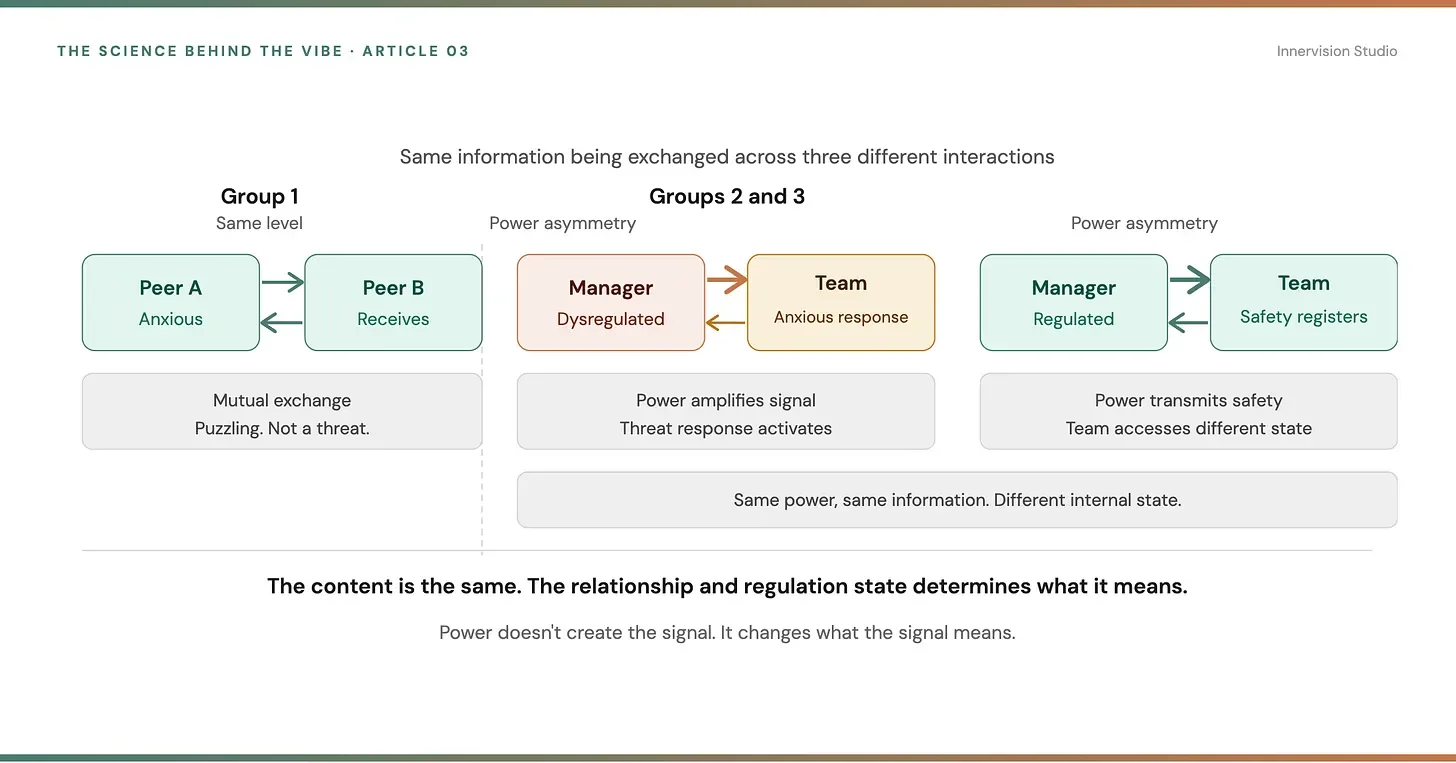
Image Source: Innervision Studio
The Comfort Trap: Warmth is a signal. Safety is a state.
They’re not the same thing, and confusing them is where a lot of leadership presence goes wrong. A warm person makes you comfortable. A safe person makes it possible to be uncomfortable — to say the true thing, to name what isn’t working, to stay in a hard conversation rather than manage your way around it. Warmth can be an input to safety. It isn’t a substitute for it.
Animals make this undeniable, because there’s no social layer to hide behind.
A horse detects dysregulation from across a field. Not your words, not your intentions — your cortisol, your breath rate, the tension in how you’re holding yourself. It won’t engage until you’re settled. You can’t talk your way back in.[4]
What’s interesting is that different animals respond to completely different regulatory signatures — the same varieties we see in humans, just without the social layer on top. A horse won’t engage until you’re grounded. A dog synchronizes with whatever you bring. A rabbit appears fine right up until it doesn’t. A monkey needs to know you can hold your state before it’ll trust you.[5]
These are useful as shorthand for the types of interactions you navigate, not fixed personality types. You might be a monkey with one person and a rabbit with another, depending on the power dynamic and how much safety has accumulated between you. The animal describes the interaction, not the person.
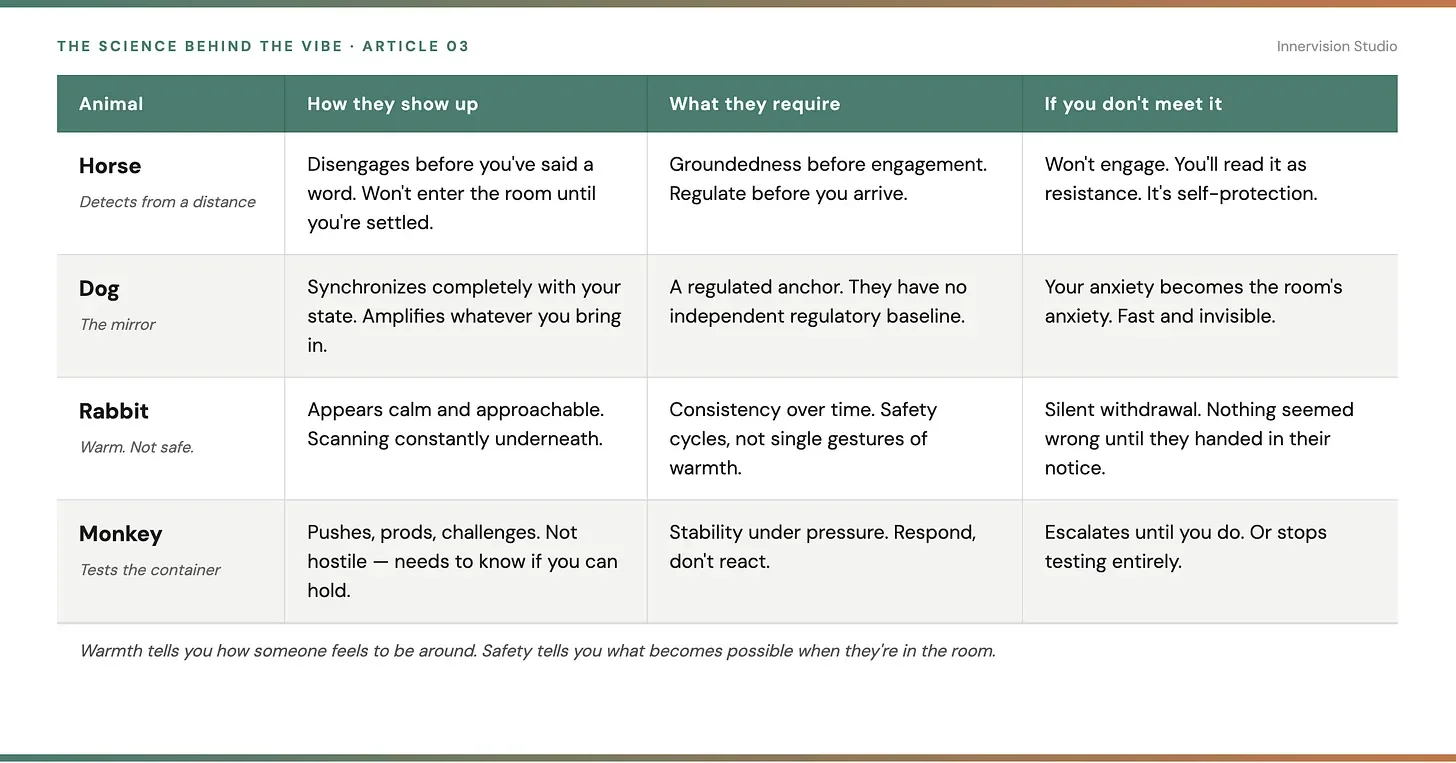
Image Source: Innervision Studio
You probably have all four in your team right now. The question isn’t which is easiest. It’s whether your state is stable enough to meet each of them where they are. Warmth tells you how someone feels to be around. Safety tells you what becomes possible when they’re in the room.
Call it your nervous system, your vibe, your energy — the label matters less than the mechanism. What you carry into a room is felt by everyone in it before you’ve spoken, transmitted through channels you can’t fully manage, to people whose systems are calibrated to read you precisely because you have influence over their lives. Add any power differential and it amplifies further. It’s what determines everything else in the room.
Most people understand this in theory. What’s harder is building the range to work with it in practice — to move through stressful situations without losing your signal, to stay regulated not as a performance of calm but as genuine capacity. The difference between the two is felt immediately by the people around you. [6] Your team knows which one you’re in.
The practice isn’t getting to a place where hard things don’t activate you. It’s building enough range that you can move through activation without losing your signal and come back without needing the room to have waited for you.
Regulating yourself before a hard conversation isn’t self-care. It’s the precondition for the conversation being useful at all. Your energy commands the room whether you intend it to or not. The question is whether you’re building the capacity to work with that consciously — especially when things are hard.
A horse, a dog, a rabbit, a monkey...they each need something different from you. What they share is that they need you to be there first. Not performing there. Actually there.
If you want to understand your own regulatory signature: what you’re transmitting, what it costs you, and where the gaps are — that’s worth 15 minutes to look at properly.
References
Porges, S.W. (2003). The polyvagal theory: Phylogenetic contributions to social behavior. Physiology and Behavior, 79(3), 503–513. — Neuroception as the neural process that evaluates risk without requiring conscious awareness.
Porges, S.W. (2011). The Polyvagal Theory: Neurophysiological Foundations of Emotions, Attachment, Communication, and Self-Regulation. Norton. — Social engagement system, prosody, facial expression as safety cues.
Feldman, R. (2007). Parent-infant synchrony and the construction of shared timing; physiological precursors, developmental outcomes, and risk conditions. Journal of Child Psychology and Psychiatry, 48(3–4), 329–354. — Physiological co-regulation and synchrony across relationship types.
McCormick, C.M. et al. (2020). Equine-assisted interventions for veterans with PTSD: A systematic review. Military Medical Research, 7(1). — Horse sensitivity to human autonomic states and cortisol as a mechanism in equine-assisted therapy.
Beetz, A., Uvnäs-Moberg, K., Julius, H. & Kotrschal, K. (2012). Psychosocial and psychophysiological effects of human-animal interactions: The possible role of oxytocin. Frontiers in Psychology, 3, 234.
Siegel, D.J. (2012). The Developing Mind: How Relationships and the Brain Interact to Shape Who We Are. Guilford Press. — Interpersonal neurobiology, regulatory resonance, and how safety accumulates through repeated interaction.