How to End Something Without an Ending
Key Notes:
Prolonged silence is information.
Letting patterns unfold without interference reveals trajectory more clearly than repeated attempts at why silence is happening.
Closure is an internal skill, not something another person provides.
Most people can point to at least one situation that never received a clear ending.
A connection that seemed promising but stalled. An interview process that went quiet after positive signals. A friendship that slowly drifted without a conversation to explain why.
Nothing explicitly went wrong. There was no clear rejection. Just a growing absence where momentum used to be. While these experiences are common, they often trigger disproportionate anxiety because the signal isn’t explicit.
What follows is an attempt to name what is actually happening in these moments and how to respond without chasing clarity or abandoning self-trust.
When Silence Is the Signal
Many situations that feel unresolved aren’t actually unclear – they are simply implicit.
We tend to assume that clarity requires explicit communication: a message, an explanation, a clearly stated conclusion. In low-context[1]
cultures especially, meaning is expected to be stated directly. When those signals don’t arrive, we treat the absence as missing information rather than as information itself. In practice, prolonged silence or lack of movement is often the signal.
Silence is difficult not because it means nothing, but because it says nothing outright. Without a stated position, the mind begins searching for one. This is where interpretation often turns into story.
A Common Pattern in Moments of Silence
When silence stretches on, a few familiar patterns tend to emerge.
People begin to notice small shifts early– changes in timing, tone, responsiveness, or effort. Nothing is overtly wrong, but something is clearly different. The situation feels different before it feels explained.
Internally, the response often sounds measured and reasonable:
I don’t want to assume.
I might be misreading this.
I’d rather be generous than reactive.
Maybe it will clarify itself if I wait.
In many contexts, this reflects emotional intelligence and restraint. Pausing isn’t inherently the problem; it’s what happens when it quietly extends.
Over time, hesitation to trust what’s already being noticed can turn into prolonged ambiguity. That ambiguity lingers because accepting what’s already visible can feel premature without explicit confirmation.
What looks like patience from the outside is often a reluctance to accept one’s own perception. The result is waiting for permission to trust what’s already been noticed.
My question here is: what exactly changes once that permission is granted?
Before answering that, it helps to step back and distinguish between signal and explanation.
Signal, Explanation, and Where the Ball Is
Signal consists of observable behavior: responsiveness, consistency, follow-through, and direction of effort. It is cumulative rather than momentary, and it tends to clarify over time rather than fluctuate.
Explanation is the narrative layer added afterward. It attempts to contextualize the signal in ways that soften its implications or postpone acceptance. Explanations may be plausible or generous, but they don’t change the underlying pattern.
This distinction applies across contexts. In relationships, it can look like interest without consistency, warmth without initiation, or communication that never translates into action. In hiring or professional processes, it often appears as enthusiastic conversations followed by indefinite silence, timelines that repeatedly slip, or momentum that quietly stalls.
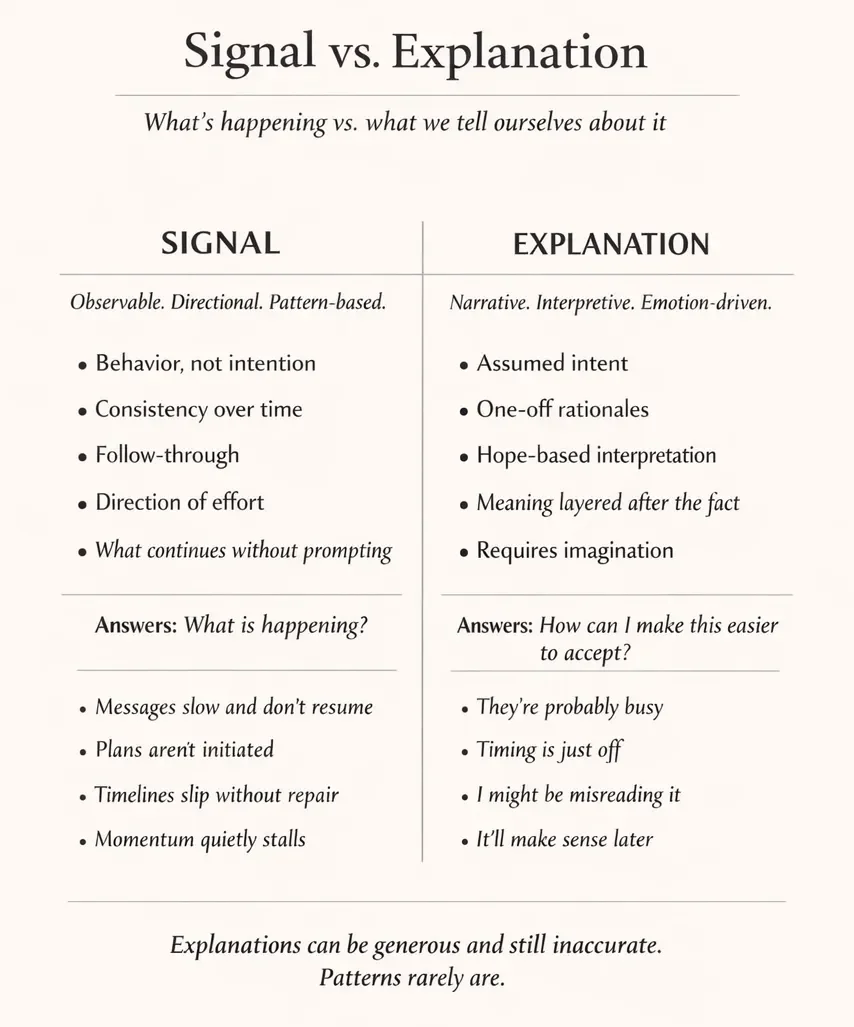
Image Source: Innervision Studio
A useful way to understand this is through tennis.
Tennis requires two players. The game only continues if the ball is being returned. At any given moment, the most important thing to observe isn’t how much you want to play, but where the ball is.
If the ball is in your court, it’s your move.
If you’ve hit the ball and it hasn’t returned, the responsibility no longer belongs to you.
Explanation often sounds like trying to imagine why the ball hasn’t returned. Signal is simply noticing that it hasn’t.
Waiting, in this sense, doesn’t mean standing still indefinitely. It means recognizing that play has paused because the other side hasn’t returned the ball. Continuing to swing when it’s no longer in play doesn’t restart the game. It only introduces noise and obscures the pattern. In this sense, silence indicates where the ball is. It’s no longer with you.
Silence, left uninterrupted, tends to be informative. It shows where responsibility currently sits, without requiring interpretation.
When Clarifying Becomes Chasing
Once it becomes apparent that silence is the signal, continuing to push for clarity often has the opposite effect.
The impulse to chase is usually driven by understandable aims: clarity, reassurance, or the hope of restoring momentum. In practice, the effect is often the opposite. Pursuit introduces pressure where engagement has already diminished and shifts responsibility for movement onto one side. Even when it elicits a response, it rarely produces resolution.
Chasing creates internal dissonance, you begin acting in ways that contradict what you have already observed. That tension—knowing something has shifted, but acting as though it hasn’t—can be more unsettling than the silence itself.
There is, however, a clean middle ground between chasing and disengaging entirely.
If there is genuine uncertainty, clarifying once is reasonable. A single, direct attempt to check whether communication has landed or whether interest still exists can be both self-respecting and regulating. The distinction lies in containment.
Clarify once. Don’t escalate. Don’t reinterpret the outcome.
If clarity is met, you have information.If clarity isn’t met, that absence is also information. Repeated attempts to clarify after silence has already answered the question tend to morph inquiry into pursuit.
Internal closure begins when unmet requests for clarity are allowed to stand as data, rather than as invitations to try again.
What Silence Reveals About Relational Posture
Silence often becomes unsettling when it runs up against what was hoped for.
When expectations and reality diverge, the mind tries to close the gap. This is where anxiety loops and rumination emerge. People replay conversations, scrutinize small details, or construct narratives about what should have or could have happened. The effort is less about understanding the situation and more about easing the discomfort of unmet expectations.
Disappointment, frustration, and even a sense of being wronged are valid emotional responses. But emotional truth doesn’t automatically translate to interpretive accuracy.
What often goes unnoticed is that the story taking shape in these moments is entirely internal. The other person may be operating from a different frame altogether, or may not be orienting toward the situation at all.
Silence is rarely experienced symmetrically. What feels unresolved on one side may already feel complete on the other.
Feeling wronged by silence is therefore often less about the silence itself and more about an unexamined expectation. It can point to questions worth asking quietly, without self-reproach:
Was I investing more than the structure of the situation supported?
Did I continue engaging while privately hoping for something that had not been established?
Was I giving in a way that assumed future reciprocity?
These questions point toward relational posture, not blame.
Relational posture describes how someone positions themselves in uncertainty: how much they give, how quickly they assign meaning, and how they manage asymmetry in interest or effort. When posture and reality drift out of alignment, silence can feel like a rupture rather than information.
There’s also something clarifying about allowing a person’s pattern to unfold without interruption. When we resist the urge to rescue momentum, manage ambiguity, or smooth discomfort on someone else’s behalf, we get a cleaner view of how they operate naturally. Silence, left alone, often reveals more than silence repeatedly disrupted.
This is especially relevant for people—often women—who are skilled at relational labor and accustomed to helping things along. Over-management can obscure the very signal it’s meant to resolve. When engagement is sustained primarily through one person’s effort, it becomes difficult to tell the difference between mutual interest and maintenance.
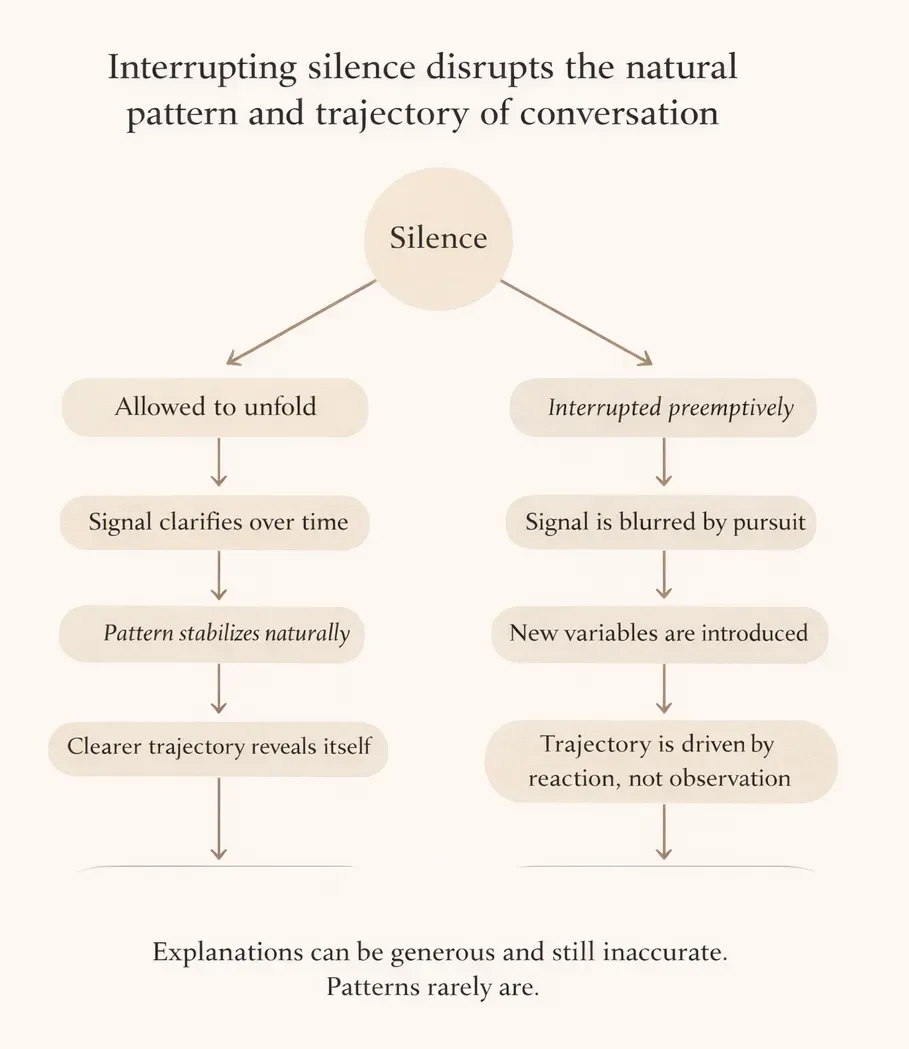
Image Source: Innervision Studio
Closure as an Internal Capacity
Closure is often framed as something another person provides. In reality, it’s a skill.
Internal closure occurs when someone recognizes that they have sufficient information to stop engaging, even without a formal ending. It doesn’t require agreement, explanation, or acknowledgment from the other side. It requires trust in your own perception — and the willingness to let that be enough.
A useful question in moments of uncertainty is not What might this mean? but If nothing changes, what is already being demonstrated?
Patterns don’t need explanation to be instructive.
[1] Low-context cultures generally include countries such as the United States, Germany, Switzerland, the Netherlands, and the Nordic countries, where communication norms emphasize directness, explicit verbal clarity, and stated expectations. In these contexts, silence is often experienced as a lack of information, rather than as a signal in itself.